NWB News

PyNWB 4.0.0 Released
 June 30, 2026
 announcement, software, pynwb, release
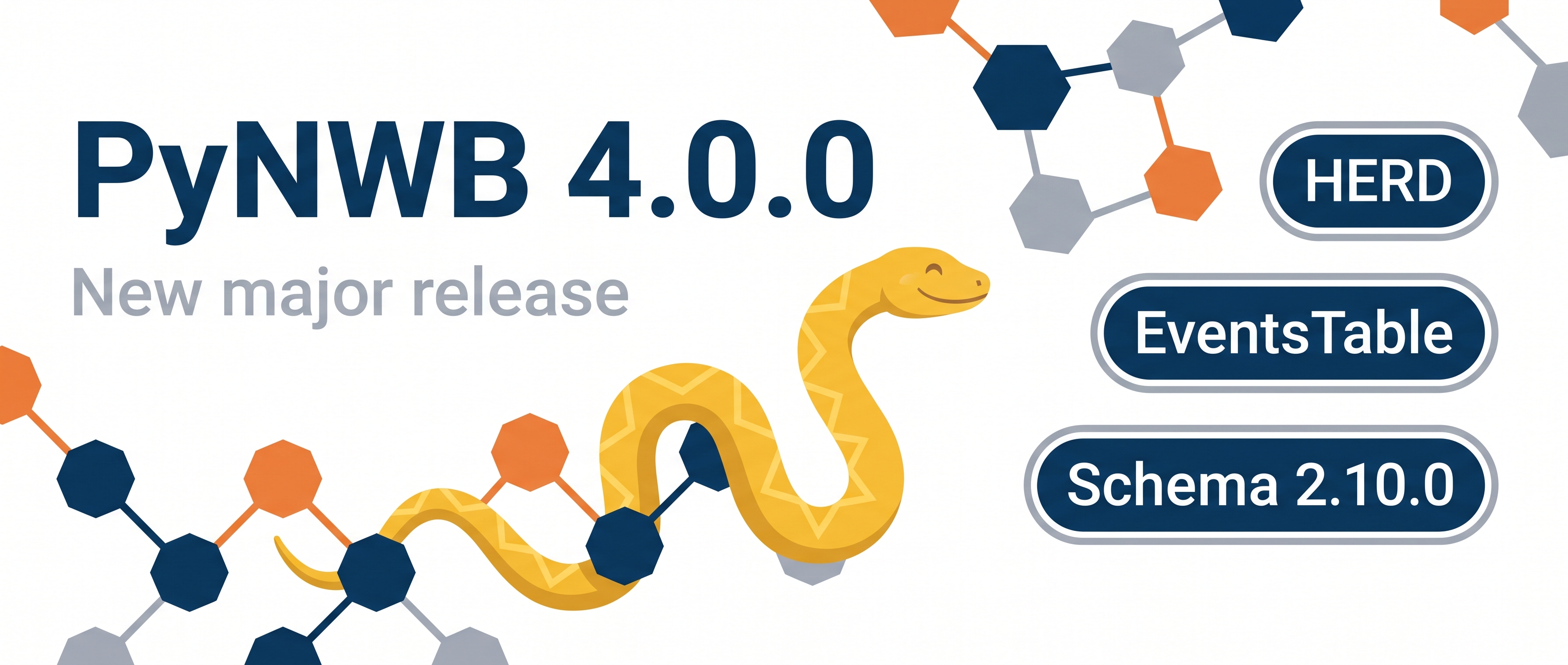
We’re excited to announce the release of PyNWB 4.0.0, the latest major version of the Python reference API for reading and writing Neurodata Without Borders files. This release pairs two long-anticipated capabilities, HERD external resource annotations and the NWBEP001 EventsTable, with the new NWB 2.10.0 schema, alongside expanded Python support and a round of cleanup that removes long-deprecated functionality.
HERD: linking NWB data to external resources
A headline feature of PyNWB 4.0.0 is support for HERD (the HDMF External Resources Data structure), exposed as the new external_resources field on NWBFile.
HERD provides a standardized way to associate external resource annotations with the contents of your NWB file. The most common use case is mapping entries in your data, such as species, brain regions, genotypes, or behavioral conditions, to terms in external ontologies and controlled vocabularies. Instead of recording a free-text label like “mouse,” you can link that value to a precise, globally resolvable identifier (for example, an NCBI Taxonomy term), making your data more machine-readable, interoperable, and FAIR.
To get started, see the new tutorials: Linking to External Resources (HERD) and Annotating Multiple Streamed NWB Files with a Single HERD.
NWBEP001 and the EventsTable
PyNWB 4.0.0 also integrates NWBEP001, the first NWB Enhancement Proposal to graduate into the core standard. NWB Enhancement Proposals are the formal mechanism for proposing broadly useful additions to the NWB specification; they are typically prototyped and refined as NWB extensions (NDX) before being folded into the core schema. NWBEP001 followed exactly this path, and its acceptance brings a dedicated, standardized way to represent events in NWB.
This release adds the new neurodata types defined by the proposal:
EventsTable: a table for storing events, including asource_descriptionattribute documenting where the events came fromTimestampVectorDataandDurationVectorData: column types for event timing and durations- A new
eventsgroup onNWBFileto hold event tables MeaningsTable: a table for documenting the meaning of categorical column values of another table, such as the events table
NWBFile also gains convenience methods for managing multiple event tables, including merge_events_tables() to combine event tables and get_all_events() to retrieve all events across the file.
More new capabilities
Beyond the two headline features, PyNWB 4.0.0 adds several quality-of-life improvements:
- New
get_starting_time()andget_duration()methods onTimeSeries,TimeIntervals, andUnits - Python 3.14 support, and a bump to HDMF ≥ 6.1.0
- pandas 3.0 compatibility
It also resolves a number of bugs, including fixes to TimeSeries.get_timestamps() for numpy arrays, round-tripping of Units waveform metadata, and parsing of legacy Device.model strings.
Breaking changes
As a major release, PyNWB 4.0.0 removes functionality that has been deprecated for some time. Highlights include:
- Removal of the deprecated
ProcessingModulemethodsadd_container,get_container,add_data_interface, andget_data_interface - Removal of the
extensionsargument fromget_type_map,get_manager, andNWBHDF5IO - Removal of the
notesargument and property fromScratchData - Removal of the
ic_electrodesargument fromNWBFile - Removal of the
pathsargument frompynwb.validate NWBFile.icephys_filteringis now read-only- Python 3.9 is now deprecated
If your code relies on any of these, review the full release notes before upgrading.
Get started
You can upgrade today:
pip install --upgrade pynwb
For complete details, see the PyNWB 4.0.0 release notes and the PyNWB documentation. Questions and feedback are always welcome on the NWB Helpdesk.
Subscribe to our mailing list to stay up to date on PyNWB releases and other NWB news.
Related Posts